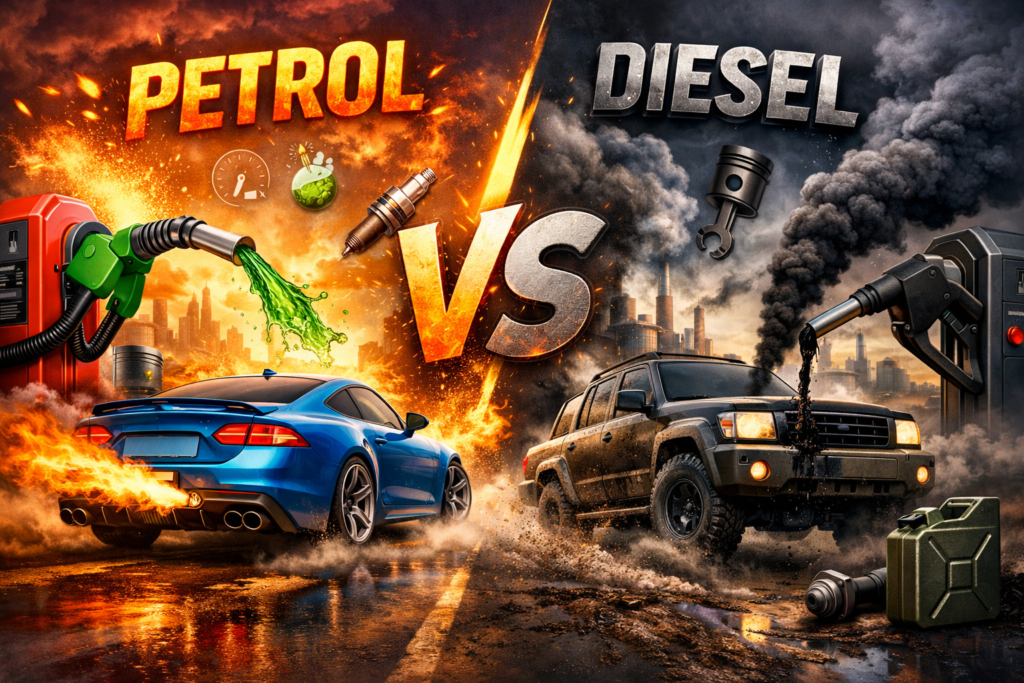
In the Indian car market, buyers have too many choices when choosing a vehicle. One of the most common among the buyers is to whether buy a diesel car or a petrol car. We see a lot of Petrol-powered vehicles being the highest seller in the car market, while diesel vehicles have seen slower growth in sales. This raises an important question, which engine type is considered frugal and pratical to the buyers in 2026?
Petrol Cars: Advantages
Petrol cars are generally preferred for short city commutes because they are easier to maintain and produces less noise compared to a diesel car. They are also suitable for occasional driving and has relatively lower service cost. However, this depends on the brand and the specific model of the vehicle. So, buyers should make their decisions wisely because reliability and robustness matter a lot when buying a car.
Modern petrol engines are available in different types, including turbocharged engines and naturally aspirated engines. Naturally aspirated engines are easier to maintain due to its simpler engineering and better mileage, while turbocharged engines offer throttle response and improved efficiency. It also offers better cabin insulation when driving on road and less vibrations.
Petrol Cars: Disadvantages
While petrol cars are often preferred for better maintenance and less service costs, they also come with limitations that buyers should consider. One of the main disadvantages is lower fuel efficiency compared to diesel cars. In the cases of driving in the way, petrol cars may lead higher fuel expenses due poor efficiency.
Petrol engines also produce low-end torque due to lower compression ratios which will make the engine struggle to deliver a linear power at low speeds. Also, it lacks pulling power as it produces less torque than diesel. That is why diesel vehicles often preferred for carrying heavy loads and longer commuting.
Diesel Cars: Advantages
Despite diesel cars have seen slower growth in the car market, they are often preferred for better fuel efficiency because they operate with higher compression ratio which produces more torque and offers better low-end torque at low engine speeds. This diesel cars an absolute powerhouse when accelerating and carrying heavy loads or steep roads.
Diesel cars have less consumption in a long-distance travel making it more sustainable. They are also known for their durability when used regularly. If the diesel engine is well maintained they can last for many years and handle demanding driving conditions regularly.
Diesel Cars: Disadvantages
Despite their advantages, diesel cars do come with certain drawbacks. One of the most noticeable issues is engine noise and vibration. Diesel engines produce more vibration and noise due to engine operating at higher compression ratio which can affect the cabin insulation. Since the implementation of BSVI emission norms, car makers are forced to comply with the regulations to meet the modern emissions standards and because of that modern diesel cars are always installed with Diesel Particulate Filter (DPF) which may not function properly when the car is mostly used for short city trips and that can lead to higher maintenance
Diesel cars have higher service costs when they are not driven frequently and that can lead to poor reliability. Also, the implementation of BSVI emissions norms has affected the sales of diesel cars in the market, yet there are some car makers such as Hyundai and Mahindra selling diesel cars. Although we must think and choose wisely on buying a car because in the future of Indian mobility where there is implementation of emission norms, diesel cars may not survive in the Indian market.
Conclusion
Both petrol and diesel cars have their own advantages and disadvantages. Petrol cars offer lower service cost in the city and generally better for shorter commutes. On the other hand, diesel cars offer better fuel efficiency and stronger torque, which is suitable for heavy usage and long-distance travel. Ultimately, the choice between petrol and diesel depends on the driver’s needs, budget and driving habits. Buyers who mostly drive within the city can buy petrol cars, while those who travel long distances will buy diesel instead as it is more economical and offers better torque. Therefore, buyers should be wise enough to make decisions.